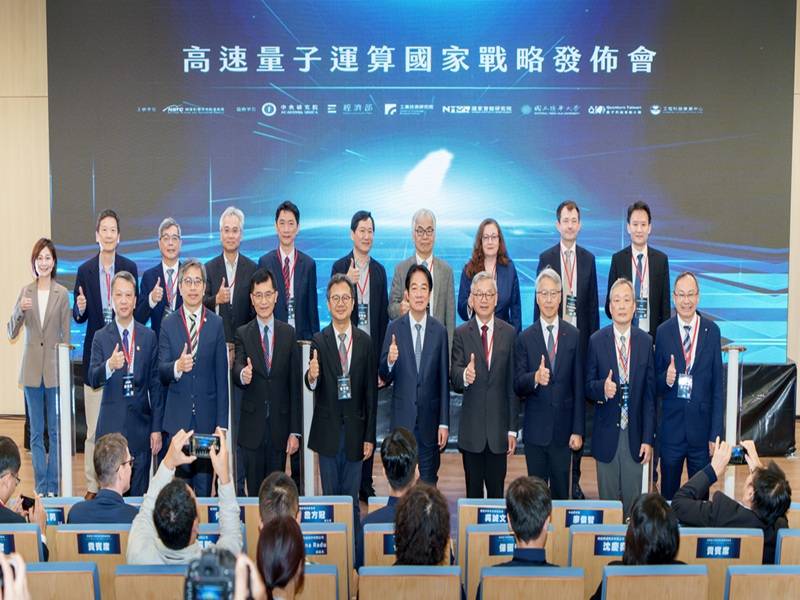
GOALS: Phase two of the initiative aims to see advancements in quantum hardware, achieve fault-tolerant quantum computing and improve practical industry applications
By Wu Po-hsuan and Jake Chung / Staff reporter, with staff writer and CNA
Taiwan would leverage its edge in advanced semiconductor manufacturing to build key supply chain partnerships with like-minded countries and secure a strategic role in the global quantum ecosystem, President William Lai (賴清德) told a news conference held by the National Science and Technology Council (NSTC) in Hsinchu yesterday.
The NSTC unveiled Phase 2 of the National Strategy for High-Speed Quantum Computing, which Lai said marks “Taiwan’s quantum technology moving from basic research to practical applications.”
Industry representatives from domestic and international companies, including Wistron Corp (緯創), Hermes Epitek Corp (漢民), Compal Electronics Inc (仁寶) and Finland-based IQM, also attended.
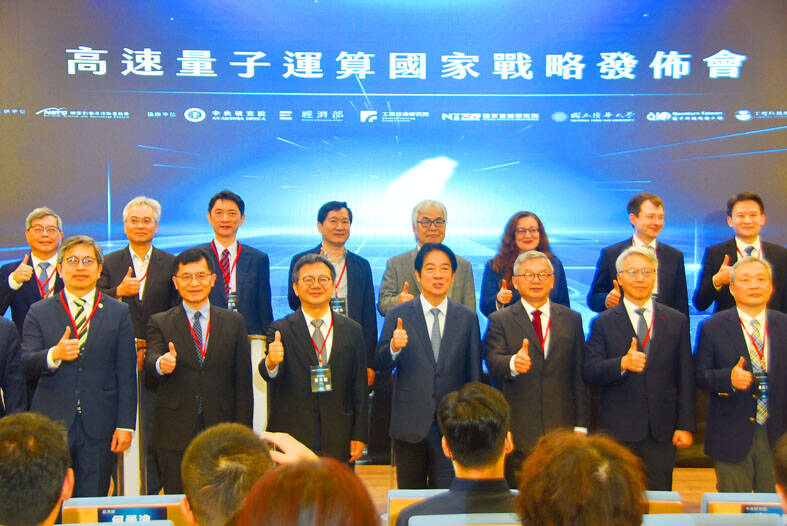
President William Lai, front row, center, poses for a photograph at a news conference hosted by the National Science and Technology Council in Hsinchu yesterday.
Photo: Wu Po-hsuan, Taipei Times
The quantum initiative is a key component of the government’s 10 Major AI Infrastructure Projects, as the development of quantum computing is closely tied to semiconductor manufacturing, Lai said.
The program is also the second stage of a national strategic plan being carried out by the National Quantum Consortium, a collective of 20 research teams, NSTC Minister Wu Cheng-wen (吳誠文) said.
Phase 1 involved the development of competitive superconducting qubit chips, silicon-based spin qubits, and low-temperature readout and control modules, Wu said, adding that the advances demonstrate that Taiwan has the potential for a fully self-sustained supply chain, from chip design and manufacturing to packaging, and key control and readout modules.
The strategy consists of four key components: launch a verification platform in northern Taiwan, establish a high-performance quantum computing center in southern Taiwan, develop supply chains for the industry, and invite international partners to jointly develop software and systems, Wu said.
The effort aims to improve hardware to achieve fault-tolerant quantum computing and to collaborate with Taiwan-friendly democratic partners on next-generation high-speed quantum computing frameworks, he said.
High-speed quantum computing would require the integration of central processing units, graphics processing units and quantum processing units, Wu said.
Lai pledged support for Phase 2 of the quantum technology initiative, calling for collaboration between industry, the government, academia and researchers.
“The nation needs you, and you must give your all to research and development,” he said, adding that quantum technology capabilities, talent development and quantum cybersecurity would be developed to ensure Taiwan’s digital resilience.
“Taiwan aims to establish key partnerships with like-minded countries to secure a critical position in the global high-speed quantum computing ecosystem,” Lai said.
He also invited international quantum teams to collaborate with Taiwan to accelerate the development and commercialization of high-speed quantum computing systems.
Consortium convener Felix Gwo (果尚志) said the wave of technological change is rare and advances in artificial intelligence would make quantum computing increasingly important.
The consortium, integrated and launched in 2021, has achieved its first-phase goals, including the development of quantum computers, quantum communication and quantum software, Gwo said, adding that Academia Sinica has completed a 20-qubit superconducting quantum computer.
The goals for the next five years of Phase 2 include advancements in hardware, aiming to achieve fault-tolerant quantum computing and expanding software capabilities to improve practical industry applications, he said.
There are also plans for international collaboration, ensuring that Taiwan’s quantum research becomes a partner in the quantum ecosystem, he said.
Additional reporting by Hung An-chi
Source: TAIPEI TIMES